

What is time-restricted eating?
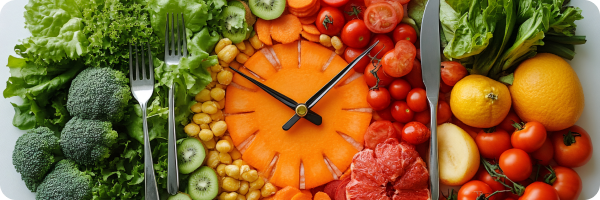
Time-Restricted Eating (TRE), sometimes called ‘intermittent fasting’, is an approach that focuses on when you eat, rather than what you eat.
That means you don’t need to count calories or follow a strict diet. Instead, you simply choose a daily eating window, such as from 8am to 6pm, and eat all your meals and snacks within that time.
Why does the timing matter?
Our bodies follow a natural 24-hour rhythm, often called the body clock or circadian rhythm. This clock helps control how we process food, use energy, and rest.
When you eat in tune with this rhythm – mostly during daylight hours – your body can work more efficiently.
Time-restricted eating and digestion: Overall health benefits
Research shows that aligning your eating times with your body’s natural rhythm may:
- Help regulate blood sugar and metabolism
- Support a healthy heart
- Promote better digestion and a balanced gut microbiome
- Improve energy levels and even sleep quality
The best part?
You don’t have to change what foods you eat, just when you eat them.
By giving your body regular meal times and time to rest between eating periods, you help it function at its best naturally.
IBS and Time-Restricted Eating (TRE): what we know so far
While TRE isn’t currently included in NICE guidance for managing Irritable Bowel Syndrome (IBS), early research suggests it might support gut health by helping the body work more closely with its natural internal clock (known as the circadian rhythm).
Gut motility (movement) and IBS bloating and fasting
Eating at regular times during the day, and avoiding late-night eating, may help your digestive system move more smoothly and reduce bloating.
- A 2024 review found that aligning meal times with the body’s natural rhythm helped improve gut movement and comfort in people with IBS-like symptoms and fibromyalgia.
- Another study suggested that structured eating windows, like in TRE, may improve bowel regularity and ease bloating by keeping digestion in sync with body’s internal clock.
However, no large clinical trials have yet tested how TRE affects bloating or bowel habits in people specifically diagnosed with IBS.
Gut health and intermittent fasting: the gut microbiome and short-chain fatty acids
Your gut is full of helpful bacteria that produce substances like short-chain fatty acids (SCFAs), which protect your gut lining and reduce inflammation.
Gut dysbiosis is an imbalance in your gut’s microbial community, where harmful bacteria may outnumber beneficial ones, or there’s a loss of overall diversity, affecting digestion and overall health. This imbalance disrupts normal gut functions and is linked to various issues like bloating, diarrhoea, and inflammation.
Some studies show that TRE can increase the diversity of these gut bacteria and aid recovery from gut dysbiosis.
A systematic review of seven different studies in humans also found that some time restricted eating and intermittent fasting interventions increased microbial diversity. However, we found no studies yet that specifically involved people with IBS.
Inflammation and gut comfort
TRE might also help lower mild, long-term inflammation that can affect gut comfort.
- One 30-day study found TRE reduced some inflammation-related gene activity.
- Other reviews suggest that eating in tune with your body’s internal clock may reduce oxidative stress, which is a type of internal inflammation.
But again, these studies were not done in people with IBS, so more research is needed to know how relevant these findings are to those that live with the condition.
Sleep, energy, and stress
Regular meal times may also help improve sleep, energy, and stress levels by keeping your body’s internal rhythms steady.
Reviews of existing evidence have found that it seems, in general, eating on a consistent schedule can support hormone balance and gut–brain communication.
Whilst once again studies specific to IBS were few and far between, the current body of evidence suggests it may be worth trialling to see if supporting your hormonal rhythm in this way could help.
What we still don’t know about time-restricted eating for IBS
Most TRE studies so far have been:
- Small and short-term (usually 2–12 weeks)
- Focused on healthy adults or those with metabolic issues, not IBS
- Aimed at metabolism or weight rather than digestion
So far, no large studies have directly tested TRE in people with IBS. The early results are encouraging, but not yet strong enough for clinical recommendations.
Theoretical insights: time-restricted eating and IBS subtypes
| IBS subtype | Key gut feature | Potential TRE benefit | Best-fit TRE timing |
|---|---|---|---|
| IBS-C (constipation-predominant IBS) | Slow motility | Stimulates morning bowel rhythm, reduces bloating | Might respond best to early-day TRE (avoiding late eating) and maintaining hydration and fibre to prevent stool hardening. (e.g., 8am–6pm). |
| IBS-D (diarrhoea-predominant IBS) | Fast motility, inflammation | Stabilises stress hormones, reduces urgency | Explore mid-day eating windows and smaller, more evenly spaced meals during the eating phase to avoid large intestinal volume shifts, (e.g., 10am-8pm). |
| IBS-M (mixed) | Fluctuating motility | Improves microbial balance and rhythm stability | May benefit from a consistent 10–12-hour eating window, with an emphasis on rhythm rather than restriction – regular sleep, stress management, and balanced meals are key. |
| IBS-U (unclassified IBS) | Irregular pattern | Reinforces routine, may improve sleep/stress | Could use TRE as a structure-building tool – maintaining predictable routines around eating, sleep, and stress. |
But remember…

These are theoretical insights drawn from circadian and microbiome research – not clinical prescriptions.
There are no large IBS-specific trials confirming these effects. TRE should be adapted cautiously, with professional guidance, especially if symptoms worsen or dietary restriction triggers anxiety or disordered eating.
TRE may help your gut feel more balanced by improving meal timing and supporting healthy gut bacteria, but research is still catching up. If you’d like to try TRE, do it gently and talk with your GP or dietitian first, especially if your IBS symptoms are unpredictable or you have other health conditions.
Summary of the potential benefits of time-restricted eating for IBS
- Reduces grazing and snacking, which may lower fermentation load

By ‘lowering fermentation load’ we’re referring to grazing and snacking limiting the amount of excess carbohydrates reaching the colon. This helps lower fermentation by gut bacteria, resulting in reduced gas production, bloating, and urgency.
- Helps keep your digestive system moving regularly between meals, ensuring food and waste move through smoothly
- May reduce post-meal bloating and urgency in IBS-D
- Encourages meal planning and food mindfulness
- Might improve sleep quality, by aiding hormone regulation and supporting the gut–brain axis
❗Potential pitfalls time-restricted eating for IBS
– Skipping meals and inconsistent meal timing can increase gut–brain stress, worsening cramps or urgency.
– Large or late meals may trigger bloating and pain.
– TRE may reinforce potentially dangerous restrictive eating behaviours, especially in people with food anxiety.
– TRE can lead to reduced fibre or fluid intake if not planned carefully.
Is time-restricted eating safe for IBS? Practical tips to try TRE safely
If you’re curious about trying TRE, keep these IBS-specific tips in mind:
✅ Choose a 10–12 hour window: Gentler on the gut than strict 6–8 hour windows
✅ Stick to 3 balanced meals with no skipping: This helps avoid erratic blood sugar and bowel flare-ups
✅ Prioritise soluble fibre, hydration, and calm meals: Prevents constipation, bloating, and stress flare-ups
✅ Track symptoms weekly: See if your symptoms improve, stay stable, or worsen
❌ Avoid TRE during active IBS flare-ups, high stress, or travel: your body needs routine, not disruption
📊 Self-check: Is time-restricted eating right for me?
Answer “yes” or “no”:
- I have regular mealtimes and don’t skip meals now
- I don’t have a history of eating disorders or food anxiety
- I can maintain my fibre and fluid intake within a shortened window
- I’m curious but willing to stop if symptoms worsen
- I can commit to trying it for 2-3 weeks and reviewing
If you answered “yes” to most, then TRE may be worth a short trial.
If it’s safe for you to try TRE, you may find a TRE timer app helpful for setting your eating window for the day with reminders. They can also help you monitor what you’re eating and are handy for avoiding IBS triggers and supporting gut-resting strategies. You can find some here.
⚠️ This article is intended for educational purposes and does not replace medical advice. Time-restricted eating is not suitable for everyone with IBS, especially those with:
– A history of eating disorders or disordered eating patterns
– IBS flare-ups, severe weight loss, or nutritional deficiencies
– Diabetes, pregnancy, or any medical condition requiring regular meals
– High levels of stress, burnout, or erratic sleep/work patterns
and those who are:
– underweight
– recovering from an illness
If you’re unsure whether TRE is right for you, speak to your GP, dietitian, or specialist before making significant changes to your eating schedule.
❗If symptoms worsen significantly, or if you experience:
– Unexplained weight loss
– Night-time diarrhoea
– Rectal bleeding
– Severe fatigue
– Mood changes related to food restriction
👉 Please stop TRE immediately and contact your GP or healthcare provider for further support.
- Bautista J, Ojeda-Mosquera S, Altamiroano-Colina A, et al. Bidirectional interactions between circadian rhythms and the gut microbiome. Applied Microbiology and Biotechnology. 2025; 109: 218. doi: 10.1007/s00253-025-13570-7.
- Carrasco-Querol N, Cabricano-Canga L, Hernández NB, et al. Nutrition and Chronobiology as Key Components of Multidisciplinary Therapeutic Interventions for Fibromyalgia and Associated Chronic Fatigue Syndrome: A Narrative and Critical Review. nutrients. 2024 Jan; 16(2): 182. doi: 10.3390/nu16020182.
- Chen Y, Li X, Yang M, et al. Time-restricted eating reveals a “younger” immune system and reshapes the intestinal microbiome in human. Redox Biology. 2024 Dec; 78: 103422. doi: 10.1016/j.redox.2024.103422.
- Dale HF, Lorentzen SCS, Mellin-Olsen T, et al. Diet-microbiota interaction in irritable bowel syndrome: looking beyond the low-FODMAP approach. Scand J Gastroenterol. 2023 Jul-Dec; 58(12): 1366-1377. doi: 10.1080/00365521.2023.2228955.
- Fatima G, Dhalla NS and Kahn S. Impact of Circadian-Aligned Meal Timing and Sleep Rhythm on Cardiovascular Health: A Comprehensive Review. Scr Med. 2025 Jul-Aug; 56(4): 723-43. doi: 10.5937/scriptamed56-59779.
- Franzago A, Alessandrelli E, Notarangelo S, et al. Chrono-Nutrition: Circadian Rhythm and Personalized Nutrition. Int J Mol Sci. 2023 Jan 29; 24(3): 2571. doi: 10.3390/ijms24032571.
- Konakchieva R, Mladenov M, Konachieva M, et al. Circadian Clock Deregulation and Metabolic Reprogramming: A System Biology Approach to Tissue-Specific Redox Signaling and Disease Development. Int. J. Mol. Sci. 2025; 26(13): 6267. doi: 10.3390/ijms26136267.
- Krsteska B and Jasar D. CHRONO-NUTRITION: HARNESSING TIME-RESTRICTED EATING FOR HEALTH OPTIMIZATION. n.d.
- NICE (2008, updated 2017) Irritable bowel syndrome in adults: diagnosis and management.
- Paukkonen I, Tӧrrӧnen E-N, Lok J, et al. The impact of intermittent fasting on gut microbiota: a systematic review of human studies. Front Nutr. 2024; 12(11): 1342787. doi: 10.3389/fnut.2024.1342787.
- Pieczyńska-Zając JM, Malinowska A, Karolina Łagowska, et al. The effects of time-restricted eating and Ramadan fasting on gut microbiota composition: a systematic review of human and animal studies, Nutrition Reviews. 2024 Jun; 82(6): 777–793. doi: 10.1093/nutrit/nuad093.
- Protocloud Technologies (2024, updated Mar 28, 2024). 18+ Free Intermittent Fasting Apps – Non-subscription 2025.
- Vizthum DA. Time restricted eating, eating behaviors, and cardiometabolic risk in emerging adults. University of Delaware. 2025.
- Zeb F, Osalii T, Obaid RS, et al. Gut Microbiota and Time-Restricted Feeding/Eating: A Targeted Biomarker and Approach in Precision Nutrition. Nutrients. 2023; Jan 4; 15(2): 259. doi: 10.3390/nu15020259.
- Zhai T, Zou X, Zhang Z, et al. Circadian rhythms of gut microbiota and plaque vulnerability: mechanisms and chrono-microbiota modulation interventions. Gut Microbes. 2025; 17(1): 2532703. doi: 10.1080/19490976.2025.2532703.