

It’s not unusual for people to take multiple medications or supplements at the same time. This is particularly the case for older people or those with long-term health conditions. Yet, doing so can result in unforeseen medicine interactions, which is why medication safety is vital.
In one study, up to 45% of patients taking part, who took at least one supplement alongside prescription medications, faced potential interactions with prescribed medicines.
What’s more, research on patients aged 65+ using both prescriptions and over-the-counter (OTC) medication and/or supplements found a 15.6% rate of potential drug interactions.

Note: It’s important to be aware that medication interactions can effect you at any age.
OTC medicines are often used in the UK to cope with pain, reflux, allergies, colds, diarrhoea, and constipation. It’s easy to think they’re always safe, because they don’t need a prescription from a doctor or pharmacist, The same goes for supplements. However, this isn’t always the case. We explain how medication interactions work and what to be aware of in order to take multiple medications safely.
Jump to section:
- Alcohol and medication interactions
- Supplements and medication interactions
- Contraceptive pills and medication interactions
What do we mean by medication “interactions”?
A medicine interaction happens when:
- one medicine alters the impact of another.
- mixing two or more medications together raises the risk of side-effects.
- a medicine and a food, supplement, or alcohol changes how the medicine works.
These interactions can happen even when:
- each medicine is taken at the correct dose.
- there are hours between taking one medicine and the other.
- one of the medicines is “only” over the counter or “just” a supplement.
Why medication interactions matter
In order to understand how to take over-the-counter medicines safely, you first need an understanding of medicine interactions. Over-the-counter (OTC) medicines don’t work alone. Once inside your body, medication can change how other medicines are absorbed, broken down, or how strongly they act.
This means combining medicines – even ones bought without a prescription – can sometimes lead to unexpected or harmful effects.
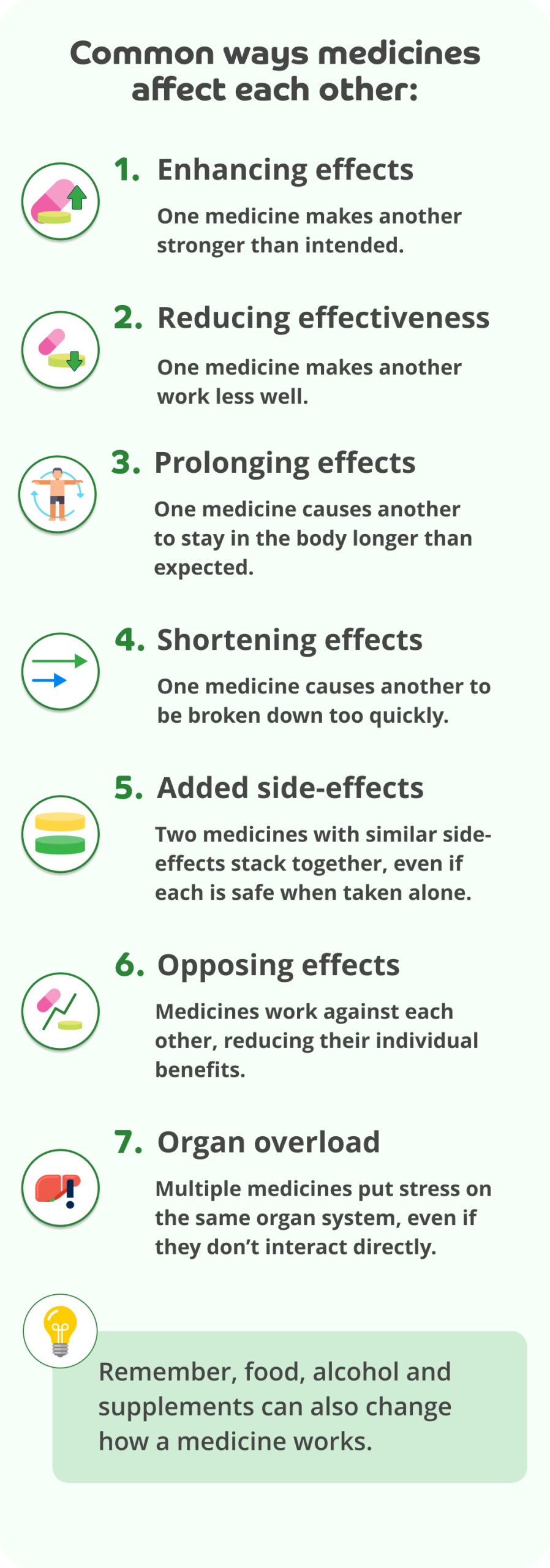
Common ways medicines affect each other:
1. Enhancing effects
One medicine makes another stronger than intended.
This can, for example:
- increase sedation (a state of calm or sleep)
- increase bleeding risk
- increase toxicity (harmful, poisonous effects)
Common examples:
- NSAIDs (non-steroidal anti-inflammatory drugs, including aspirin and ibuprofen) and blood thinners can result in a higher risk of bleeding
- antihistamines and alcohol can lead to excessive drowsiness and reduced reaction time
- codeine (an opiate used to short-term moderate pain) and sleeping tablets (e.g. benzodiazepines) can raise the risk of suppressed breathing (respiratory depression)
For a more detailed and specific breakdown of the risks common OTC-medications carry, including antihistamines, laxatives and painkillers, and common drug interactions visit our guide.
Alternatively, NICE’s (National Institute for Health and Care Excellence) BNF (British National Formulary) lists most of the known interactions with specific medicines, and the NHS’ Medicines A to Z resource can also be helpful for looking up the exact medication you take.
2. Reducing effectiveness
One medicine makes another work less well.
This can:
- reduce the control you had over your symptoms thanks to one of the medications
- increase the risk of complications
- lead to unnecessary dose increases
Examples:
- the PPI (proton pump inhibitor) omeprazole reducing absorption of iron or some antifungal medicines
- antacids (such as fast-acting OTC medications like Rennie and Gaviscon) reducing the absorption of certain antibiotics by neutralising the acid in the stomach
- some supplements binding medicines in the gut into insoluble compounds that can’t be absorbed by the body
3. Prolonging effects
One medicine causes another to stay in the body longer than expected.
This can:
- increase side-effects
- raise toxicity risk over time
Examples:
- medicines that slow liver enzyme activity, (known as hepatic enzyme inhibition), such as, cimetidine (used to treat ulcers and gastro-oesophageal reflux disease (GORD)), antidepressants and psychotropics and other selective serotonin reuptake inhibitors (SSRIs), and omeprazole, leading to higher drug levels
- certain antidepressants elevating levels of other medicines
4. Shortening effects
One medicine causes another to be broken down too quickly.
This can:
- make treatment less effective
- cause symptoms to return sooner
Examples:
- some herbal supplements speeding up liver metabolism (known as hepatic enzyme induction). These include St John’s Wort, which can accelerate the clearance of cyclosporine/or cyclosporine (used to treat severe autoimmune conditions like rheumatoid arthritis, Crohn’s disease and psoriasis), tacrolimus (used to prevent the rejection or organ transplants and treat severe atopic eczema), statins (that reduce low-density lipoprotein (LDL) cholesterol or prevent and manage cardiovascular diseases) and hormonal contraceptives (see below).
- smoking reducing the effectiveness of some medicines, such as psychotropic drugs that alter mood, thoughts or behaviour to treat mental health conditions, for instance clozapine and olanzapine.
5. Added side-effects
Two medicines with similar side-effects stack together, even if each is safe when taken alone.
This can, for example:
- increase the risk of falling
- cause confusion
- affect heart rhythm
Common examples:
- two sedating medicines can trigger severe drowsiness
- multiple medicines affecting heart rhythm and increasing arrhythmia risk
- several medicines lowering blood pressure, for example ACE inhibitors like ramipril or calcium-channel blockers, such as felodipine, can result in dizziness or collapse
6. Opposing effects
Medicines work against each other, reducing their individual benefits.
This can:
- make symptoms harder to control
- lead to unnecessary further treatment
Examples:
- NSAIDs reducing the effectiveness of some blood pressure medicines
- decongestants (medicines that ease a blocked or stuffy nose in the short-term) counteracting heart or blood pressure treatments
7. Organ overload
Multiple medicines put stress on the same organ system, even if they don’t interact directly.
This can:
- increase the risk of kidney or liver damage risk
- reduce the body’s ability to clear medicines safely
Examples:
- NSAIDs taken when dehydrated can lead to kidney injury
- mixing paracetamol and alcohol is likely to result in liver damage
- multiple medicines cleared by the kidneys in older adults (known as polypharmacy-induced renal toxicity) can overwhelm the organ, which naturally loses its effectiveness at efficiently getting rid of drugs as we age.
Can you drink alcohol while taking medication?
While the effects of taking medication or supplements at the same time as drinking alcohol will vary, depending on the medication, it’s important to know about mixing alcohol and medication risks.
Alcohol interacts with many OTC medicines by:
- increasing sedation
- raising the risk of bleeding
- increasing liver toxicity
- reducing reaction time and judgement
Even “moderate” drinking can be unsafe with some medicines, like the OTC medication codeine
According to UK guidance, “moderate drinking” is no more than 14 units per week on a regular basis, which is the limit UK Chief Medical Officers advise us to stick to. If you do drink as much as 14 units a week (regardless of if you’re taking any supplements or medication), it’s also recommended to spread drinking over several days, and enjoy alcohol-free days.
14 units is equivalent to six-seven pints of beer, depending on the strength of the drink, or six medium (175ml) glasses of average strength wine.
By comparison, the NHS defines “heavy drinking” or “binge drinking” as drinking heavily over a short time period. Another way to think about it as ‘drinking to get drunk’. Drinking more than eight units of alcohol in a single session for males, or more than six units in a single session for females is classed as “binge drinking”. That’s the same as about four pints of normal strength beer for a man or about three pints for a woman.
Examples
- Alcohol and medication interactions include alcohol and codeine. Both can negatively impact your ability to drive safe. Sometimes, combining the two can increase the risk of brain-depressant effects, for example, sedation, unconsciousness, coma, respiratory depression (breathing too slow and shallow) and/or cardiovascular depression (a serious mood disorder that often comes after a heart problem).
- People who drink heavily should avoid mixing paracetamol and alcohol because doing so can result in severe liver damage.
- Although it’s generally safe to drink alcohol while taking NSAIDs, excessive alcohol intake may cause stomach irritation. For instance, drinking a lot of alcohol when taking ibuprofen can increase the risk of side-effects.
- It’s sensible to avoid alcohol while taking omeprazole, which is often used to treat heartburn, stomach ulcers and GORD, (even if you’ve bought it OTC). This is because it can increase your stomach acid volume and worsen your symptoms.
The Evergreen Life app has an Alcohol Consumption Check to help you check in on your drinking habits.
Should you feel like you need to cut down on how much your drink, here are eight actions to help you do so.
If you’ve quit drinking recently – first of all, well done! – secondly, our article may help you keep enjoying all the benefits of an alcohol-free life.
Supplements and medication interactions
Herbal medicines and nutritional supplements (for example, vitamins) aren’t tested in the same way or to the same extent as pharmacy and prescription medicines. They’re also not usually tested for the effect they have on other medicines. However, it’s worth noting that herbal and nutritional supplements can interact with medication by:
- altering how medicines are absorbed
- speeding up or slowing down drug breakdown
- increasing bleeding or heart rhythm risk
Common examples include:
- St John’s Wort – for example, the herbal remedy may reduce the effects and blood levels of omeprazole.
- High-dose magnesium or calcium.
- Ginkgo (can interact with aspirin and codeine, among others), ginseng (can interfere with drug metabolism), and turmeric (may affect how platelets – small cell fragments in the blood – work and clotting, elevating the risk of bleeding when taken with medication like ibuprofen that have blood thinning effects).
Remember, “natural” doesn’t mean interaction-free.
Contraceptive pill effectiveness when taking other medicines
Did you know, some medicines and supplements can actually reduce the effectiveness of oral contraceptive pills by increasing how quickly the body breaks down contraceptive hormones?
The most important group are enzyme-inducing drugs (the ones that speed up enzyme activity, such as breaking down drugs in the liver). In particular these include:
- certain antiepileptic medicines (such as carbamazepine, phenytoin, phenobarbital, primidone, and high-dose topiramate),
- rifampicin-type antibiotics,
- some HIV treatments, and
- a few other drugs including modafinil (brand name Provigil, used for treating excessive sleepiness from narcolepsy and obstructive sleep apnoea) and bosentan (brand name Tracleer, used in the treatment of pulmonary arterial hypertension).
When these are used, hormone levels may fall enough to reduce contraceptive protection, so an alternative or additional non-hormonal method is recommended during treatment and for 28 days after stopping.
Herbal products can also interact. St John’s Wort is the main clinically significant example and is well documented to lower contraceptive hormone levels through enzyme induction. Another mechanism that can reduce pill effectiveness is impaired absorption. Severe vomiting, prolonged diarrhoea, or conditions or medicines that speed up how quickly things pass through the gut may stop enough of the contraceptive hormone being absorbed, particularly if symptoms occur within a few hours of taking a pill.
Do antibiotics stop the pill working?
It’s important to note that most commonly prescribed antibiotics do not interfere with contraceptive effectiveness; only rifampicin-like antibiotics have proven effects.
Contraceptive/birth control pill interactions: When they affect other medications
In contrast, oral contraceptives themselves can alter the levels of some medicines, such as lowering lamotrigine concentrations (used to treat epilepsy and prevent depressive episodes in bipolar disorder) or increasing levels of drugs like ciclosporin/(or cyclosporine) (used to prevent organ transplant rejection and treat psoriasis, rheumatoid arthritis, eczema, and Crohn’s disease) or theophylline (used in chronic asthma, COPD and neonatal apnoea treatment).
It’s advisable to speak to your healthcare provider or pharmacy for advice whenever starting a new medication or supplement while using hormonal contraception.
Taking multiple medications safely: why listing all medicines matters
Risks can only be flagged to you and/or your healthcare provider when spotting interactions in your health record or when using an online tool (such as the BNF interactions checker) if:
- every medicine and supplement you take (even occasionally) is included/shared.
- doses and frequency are accurate.
Not including just one OTC medicine or supplement can mean a key interaction is missed. OTC medicines and supplements should be treated as real medicines, not “extras”.
Recording supplements and OTC medicines all in the same accessible place, such as in your Evergreen Life Personal Health Record and sharing them during medication reviews, enables clinicians to:
- safety adjust treatment
- enhance medication and long-term condition reviews
Always tell your GP or pharmacist about OTC medicines supplements and alcohol usage during:
- medication reviews
- long-term condition checks
- hospital or clinic appointments
Key medication interactions takeaway
Medicine interactions don’t always cause immediate or obvious symptoms, but they can:
– increase side-effects quietly.
– reduce treatment effectiveness.
– create serious risks over time.
Treat OTC medicines and supplements with the same respect as prescription medicines, and always include them when checking interactions or speaking to your pharmacist or doctor.
Reviewed by:
Dr Claire Marie Thomas MRCGP DFSRH DTMH DipNLP MBChB BMedSci Medical Expert

This article provides general educational information about some medications, including over-the-counter (OTC) medicines. It is not intended to provide personalised medical advice, diagnosis, or treatment, and should not be used as a substitute for professional healthcare guidance.
OTC medicines, prescription medicines, supplements, and alcohol, can all interact with one another and each other. Their safety and suitability depend on individual factors, such as existing health conditions, other medicines being taken, age, pregnancy, and breastfeeding status.
Always read medicine labels and patient information leaflets carefully. If you are unsure about whether a medicine is appropriate for you, how long to use it, or whether it can be taken alongside other treatments, seek advice from a pharmacist or GP.
If symptoms persist, worsen, or recur, or if you experience unexpected side-effects, seek medical advice. Seek urgent help if you are concerned about a possible overdose (including accidental overdose), severe reactions, or sudden deterioration. In the UK, contact NHS 111 for urgent advice or 999 in an emergency.
OTC medicines, supplements, and occasional treatments should be included in your full medicines list. Recording them in your Evergreen Life Personal Health Record and sharing them during medication or long-term condition reviews helps reduce the risk of interactions and harm.
- Anderson S, Mauskopf J, Talbird SE, et al. Antiseizure medications and oral contraceptives: Impact of enzyme inducers on pregnancy outcomes and costs. Epilepsy Behav. 2021 Dec; 125:108368. doi: 10.1016/j.yebeh.2021.108368.
- Blood Pressure UK (n.d.) Medications for high blood pressure. [Accessed 17/02/2026].
- Department of Health (2016) UK Chief Medical Officers’ Low Risk Drinking Guidelines.
- drinkaware (2022) UK low risk drinking guidelines.
- Drugs.com (n.d.) Can You Take Cyclosporine with Levonorgestrel?. [Accessed 18/02/2026]
- Drugs.com (n.d.) Can You Take Ibuprofen with Turmeric?. [Accessed 17/02/2026].
- Drugs.com (n.d.) Can You Take Iron Sulfate with Omeprazole?. [Accessed 17/02/2026]
- Drugs.com (n.d.) Can You Take Ketoconazole with Omeprazole?. [Accessed 17/02/2026]
- Drugs.com (n.d.) Can You Take Omeprazole with St. john’s wort?. [Accessed 17/02/2026]
- Drugs.com (n.d.) Ginkgo Biloba Drug Interactions. [Accessed 17/02/2026]
- Drugs.com (2025) Ginseng.
- Drugs.com (n.d.) Interactions between Bosentan and Quasense. [Accessed 18/02/2026]
- Drugs.com (n.d.) Turmeric Drug Interactions. [Accessed 17/02/2026].
- European Heart Rhythm Association and Heart Rhythm Society, Zipes DP, Camm AJ, et al. ACC/AHA/ESC 2006 Guidelines for Management of Patients With Ventricular Arrhythmias and the Prevention of Sudden Cardiac Death: A Report of the American College of Cardiology/American Heart Association Task Force and the European Society of Cardiology Committee for Practice Guidelines (Writing Committee to Develop Guidelines for Management of Patients With Ventricular Arrhythmias and the Prevention of Sudden Cardiac Death). Journal of the American College of Cardiology. 2006 Sept; 48(5): e247-e346. doi: 10.1016/j.jacc.2006.07.010.
- GOV.UK (2020) Benzodiazepines and opioids: reminder of risk of potentially fatal respiratory depression.
- GOV.UK (2020) Press release Sleep disorder drug modafinil linked to increased risk of birth defects and also to reduced effectiveness of contraception.
- GOV.UK (2014) St John’s wort: interaction with hormonal contraceptives, including implants.
- Graham RE, Gandhi TK, Borus J, et al. Risk of Concurrent Use of Prescription Drugs with Herbal and Dietary Supplements in Ambulatory Care. Rockville (MD): Agency for Healthcare Research and Quality (US). 2008 Aug.
- Houston MC. Nonsteroidal anti-inflammatory drugs and antihypertensives. The American Journal of Medicine. 1991 May; 90(5): S42-S47. doi: 10.1016/0002-9343(91)90485-G.
- Institute of Medicine (US) and National Research Council (US) Committee on the Framework for Evaluating the Safety of Dietary Supplements. Washington (DC). Dietary Supplements: A Framework for Evaluating Safety. National Academies Press (US). 2005.
- Jaqua EE, Gonzalez J, Bahjri K, et al. Analyzing Potential Interactions Between Complementary and Alternative Therapies, Over-the-Counter, and Prescription Medications in the Older Population. Perm J. 2024 Jun; 28(2): 70-77. doi: 10.7812/TPP/23.183.
- Jolobe OMP. Use of non-steroidal anti-inflammatory drugs as a risk factor for acute kidney injury. QJM: An International Journal of Medicine. 2021 Aug; 114(8): 613. doi: 10.1093/qjmed/hcaa211.
- Kaya Z and Tuncez A. Adverse Cardiac Effects of Decongestant Agents. Eur J Gen Med. 2013; 10(Suppl 1): 32-35.
- Mersey Care NHS Foundation Trust (2025) Dizziness and medication guide.
- Mousa SA. Antithrombotic effects of naturally derived products on coagulation and platelet function. Methods Mol Biol. 2010; 663: 229-40. doi: 10.1007/978-1-60761-803-4_9.
- National Institutes of Health Office of Dietary Supplements (2025) Calcium Fact Sheet for Health Professionals.
- National Institutes of Health Office of Dietary Supplements (2026) Magnesium Fact Sheet for Health Professionals.
- Navarro V, Khan I, Bjӧrnsson E, et al. Liver Injury from Herbal and Dietary Supplements. Hepatology. 2016 Nov; 65(1): 363-373. doi: 10.1002/hep.28813.
- NHS (2023) Antihistamines.
- NHS (2025) Ibuprofen for adults (Nurofen).
- NHS (2022) Interactions Antibiotics.
- NHS (n.d.) Medicines A to Z. [Accessed 17/02/2026]
- NHS (2022) NSAIDs.
- NHS (2025) Omeprazole.
- NHS (2022) Overview Alcohol misuse.
- NHS (2021) Taking aspirin with other medicines and herbal supplements.
- NHS (2022) Taking paracetamol for adults with other medicines and herbal supplements.
- NICE (n.d.) Cimetidine. [Accessed 17/02/2026]
- NICE (n.d.) Codeine Interactions. [Accessed 17/02/2026]
- NICE (n.d.) Contraceptives, interactions. [Accessed 18/02/2026]
- NICE (n.d.) Interactions A to Z. [Accessed 17/02/2026]
- NICE (n.d.) Paracetamol Interactions. [Accessed 17/02/2026]
- Nicolson T (2020) The pill and antibiotics.
- Nowack R. Review Article: Cytochrome P450 enzyme, and transport protein mediated herb–drug interactions in renal transplant patients: Grapefruit juice, St John’s Wort – and beyond! (Review Article). Nephrology. 2008 Jun; 13(4): 337-347. doi: 10.1111/j.1440-1797.2008.00940.x.
- Office for National Statistics (2018) Adult drinking habits in Great Britain: 2017.
- Peng CC, Glassman PA, Trilli LE, et al. Incidence and severity of potential drug-dietary supplement interactions in primary care patients: an exploratory study of 2 outpatient practices. Arch Intern Med. 2004 Mar 22; 164(6): 630-6. doi: 10.1001/archinte.164.6.630.
- Sailsbury BH and Terrell JM. Antacids. StatPearls [Internet]. 2023 Aug.
- Sweeney BP and Bromilow J. REVIEW ARTICLE Liver enzyme induction and inhibition: implications for anaesthesia. Anaesthesia. 2006; 61: 159-177. doi: 10.1111/j.1365-2044.2005.04462.x.
- Tees, Esk and Wear Valleys NHS Foundation Trust (2024) Medication Safety Series: MSS 25 Tobacco smoking, smoking cessation & psychotropic drugs.
- Tornatore KM, Kanarkowski R, McCarthy TL, et al. Effect of chronic oral contraceptive steroids on theophylline disposition. Eur J Clin Pharmacol. 1982; 23(2):129-34. doi: 10.1007/BF00545966.
- Trivedi MH and Kurian BT. Managing Depressive Disorders in Patients with Epilepsy. Psychiatry (Edgmont). 2007 Jan; 4(1): 26-34. PMCID: PMC2922388 PMID: 20805926.
- Vaja R and Rana M. Drugs and the liver. Anaesthesia and Intensive Care Medicine. 2020 Sep; 21(10): 517-523. doi: 10.1016/j.mpaic.2020.07.001.
- Zhang B, Wang J, Liu N et al. Association between polypharmacy and chronic kidney disease among community-dwelling older people: a longitudinal study in southern China. BMC Nephrology. 2024 May; 25:169. doi: 10.1186/s12882-024-03606-x.
- Zhanel GG, Siemens S, Slayter K, et al. Antibiotic and oral contraceptive drug interactions: Is there a need for concern? Can J Infect Dis. 1999 Nov-Dec, 10(6) 429-433. doi: 10.1155/1999/539376.